
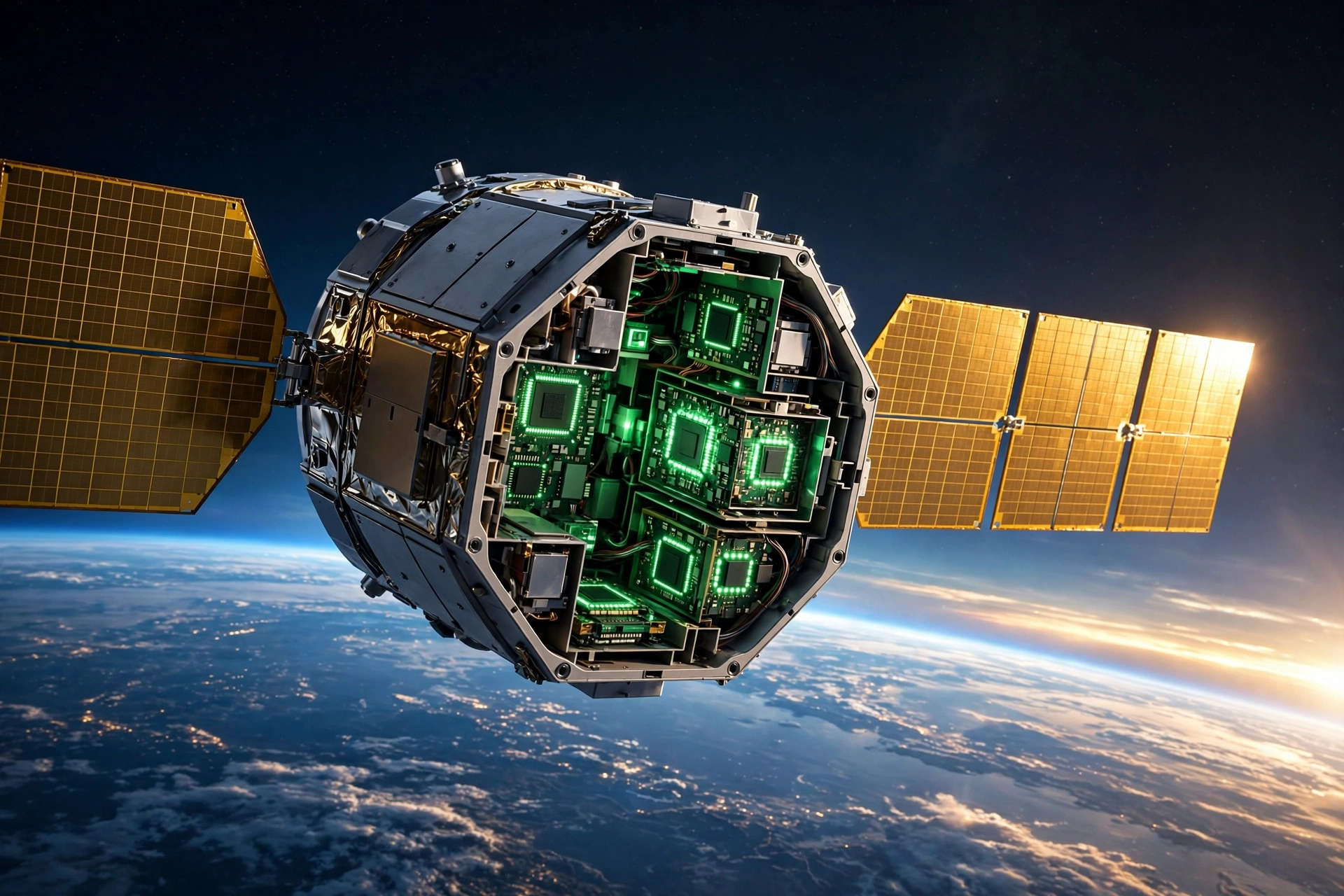
Google is about to run its most unusual data center experiment yet — hundreds of kilometers above Earth. The company’s Project Suncatcher prototype satellite, carrying four of Google’s custom AI chips, is scheduled to launch on October 1 aboard a SpaceX Falcon 9 rocket, in what could become the first real test of whether AI computing can work in orbit.
The refrigerator-sized satellite, nicknamed MVP (minimum viable product), will ride SpaceX’s Transporter-18 rideshare mission from Vandenberg Space Force Base in California, according to reporting from The New York Times. Google built the spacecraft with Planet, the Earth-imaging company, and its mission is narrow but consequential: find out whether Tensor Processing Units — the same family of chips that answer Gemini requests inside Google’s ground data centers — can survive and do useful work in space.
What Project Suncatcher is flying
Project Suncatcher MVP carries four Trillium-generation TPUs, Google’s latest tensor processing unit design, offering roughly the computing power of a standard Google Cloud TPU v6e-4 slice, according to analysis by Futurum Group. Solar panels will supply about one kilowatt of power, and the satellite will operate in a dawn-dusk sun-synchronous orbit — a path that keeps it riding the line between day and night so its panels see the sun almost constantly.
Google says panels in that orbit can generate up to eight times more solar power than the same panels on the ground, since there are no clouds, no nighttime, and no atmosphere in the way. That abundance of sunlight is the entire premise of Project Suncatcher, a research moonshot Google unveiled in November 2025: could the electricity that artificial intelligence consumes come straight from the sun, rather than from the same power grids that homes, hospitals and factories depend on?
“Can our TPUs survive and operate in space? Well, we’re going to find out,” Sundar Pichai, CEO of Google and Alphabet, said in remarks reported by Aviation Week. The flight, Google said in a September 24 mission update, is an experiment — not an orbital data center. “Some things can only be tested in space,” the company noted.
Heat is the real test
Google’s September mission update identifies three immediate hazards the flight must survive. The rocket climb lasts about 10 minutes and sustains loads reaching 10 g, with individual components experiencing peaks between 50 and 100 g. Engineers shook the satellite along all three axes before approving it for flight, according to Ars Technica’s account of the test.
Orbit adds conditions that no vibration table can fully reproduce together. Energetic particles can alter memory or scramble calculations, and vacuum removes convective cooling entirely — meaning a chip that would be air-cooled in a data center must radiate every watt of heat away into the void. Repeated passages in and out of sunlight also cycle temperatures through the structure.
Heat, in fact, may be the mission’s most revealing measurement. Google has fitted MVP with a cooling system built around heat pipes and radiators, but the system is still experimental and cannot support nonstop computing. Travis Beals, Project Suncatcher’s senior director of product management, told The New York Times that the chips can only run for about 15 minutes before they need to be turned off to cool down.
During those 15-minute windows, the plan is to run Gemini models on the TPUs. Then the radiators push accumulated heat out into space, and the cycle starts again. Fifteen minutes is a tight window for anything resembling sustained computing — which is why Google is treating this launch as a first step rather than a finished system.

The bigger vision: data centers in orbit
If the physics works, the ambition behind Project Suncatcher is enormous. Tech giants are running out of cheap electricity and available land for the huge data centers that power AI tools like Gemini and ChatGPT, and several are now looking up. Google’s designs under study call for clusters of more than 80 satellites linked by optical interconnects at 1.6 terabits per second, forming what amounts to a computing web above Earth, according to Futurum Group.
The next step after MVP is already planned: Google intends to launch two satellites in 2027 to demonstrate optical inter-satellite links. MVP itself is designed to operate for about a year and will deorbit within roughly six years, per Futurum’s analysis. Futurum estimates orbital compute could address a $1 trillion market by 2030 if launch costs collapse — though it models cost parity with off-grid terrestrial data centers only arriving in the mid-2030s, and those projections remain speculative.
“How can we efficiently scale AI infrastructure through orbital data centers by leveraging the abundant energy we get from the Sun?” asked Maria Biggs, engineering director at Google, in remarks reported by Aviation Week. Google is not alone in the race: SpaceX has its own orbital data center ambitions, and competitors including Starcloud, NVIDIA, AMD and Axiom Space are positioning in orbital compute, according to Futurum.
Notably, Google moved the MVP flight up from an original target of early 2027 — a sign, observers say, of how competitive this corner of the AI race has become. For now, though, the immediate aim stays simple: separate transient radiation faults, thermal limits and permanent damage over time, and learn what it actually takes to run AI hardware beyond the planet.
For related coverage of the AI hardware race, see our report on Nvidia’s RTX Pro 5500 and its China chip sales approval, and AMD’s $8.2 billion acquisition of World Labs.

Sources
Reporting from The New York Times (via Aviation Week), Ars Technica, and Google’s Project Suncatcher mission updates | Aviation Week: Google’s In-Orbit Data Center Chip Trial Set For October Launch | Futurum Group: Project Suncatcher prepares to launch TPUs
FAQ
What is Google Project Suncatcher?
Project Suncatcher is Google’s research moonshot, unveiled in November 2025, to explore whether AI computing infrastructure can operate in orbit. The idea is to use abundant sunlight in space to power AI chips, reducing pressure on terrestrial power grids.
When does the Project Suncatcher satellite launch?
The first prototype satellite, MVP, is scheduled to launch on October 1, 2026, aboard SpaceX’s Transporter-18 rideshare mission on a Falcon 9 rocket from Vandenberg Space Force Base, California. Launch dates can change.
What chips are on the Project Suncatcher satellite?
MVP carries four Trillium-generation Google Tensor Processing Units (TPUs), offering roughly the computing power of a standard Google Cloud TPU v6e-4 slice, with about one kilowatt of solar power.
Why is heat such a problem for chips in space?
In vacuum there is no air to carry heat away, so chips can only cool by radiating heat into space. Google’s experimental radiator system means MVP’s TPUs can only run about 15 minutes before needing a cool-down break — making thermal management the mission’s key measurement.

Leave a Reply
You must be logged in to post a comment.