

SpaceX just took two giant steps toward becoming a full-fledged mobile carrier. In the span of three days, the company won FCC approval to launch 15,000 new Starlink Mobile satellites and agreed to buy a nationwide low-band spectrum portfolio that could let satellite phone service work inside buildings — a direct challenge to AT&T, Verizon and T-Mobile.
The pair of moves, reported this week by trade outlets including Via Satellite and PhoneArena, positions Starlink Mobile to evolve from a supplemental texting service into a genuine competitor to America’s big three wireless carriers. Wall Street noticed: shares of AT&T, Verizon and T-Mobile all dropped roughly 6 percent in extended trading after the spectrum news broke.
What the FCC’s SpaceX Starlink Mobile approval covers
The FCC’s Space Bureau and Wireless Telecommunications Bureau issued the order, DA 26-1078, on October 6, 2026, approving in part SpaceX’s application to deploy and operate a 15,000-satellite constellation dedicated to direct-to-device service. SpaceX had filed for the constellation in September 2025, shortly after announcing its spectrum deal with EchoStar.
The approval covers mobile satellite services (MSS) within the U.S., direct-to-cell service outside the country, supplemental coverage from space (SCS), and fixed satellite backhaul and telemetry. The satellites will fly in nine orbital shells at record-low altitudes of 326 to 335 kilometers — closer than any major commercial constellation — which SpaceX says will reduce latency and sharpen the link between phones and satellites.
Crucially, the FCC also waived the rule that had required SpaceX to hold a spectrum-leasing agreement with a terrestrial mobile operator. That waiver means SpaceX can use its own licensed spectrum for Starlink Mobile without renting airwaves from a ground carrier — the regulatory key that lets it compete head-on with AT&T, T-Mobile and Verizon instead of operating as their junior partner.
The commission said the decision will “pave the way for SpaceX’s next-generation D2D network to extend spectrum based services to mobile systems,” arguing it improves competition and gives consumers more choices. The FCC deferred some of SpaceX’s spectrum requests, including MSS operations in the 2020–2025 MHz band in the U.S. and action on the 20.2–21.2 GHz and 30–31 GHz bands, which have heavy federal use.
How Starlink Mobile plans to beat today’s 4 Mbps satellite texting
Today’s version of the service — sold in the U.S. through T-Mobile as T-Satellite — runs on roughly 650 satellites and delivers data speeds of around 4 Mbps, according to company estimates. The new constellation promises a dramatic leap: SpaceX says the second-generation satellites will deliver 5G speeds of up to 150 Mbps per user.
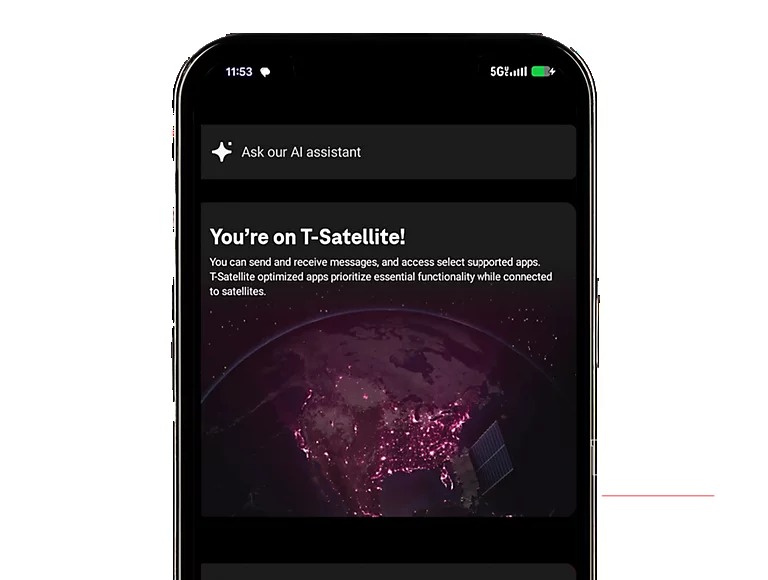
SpaceX President and COO Gwynne Shotwell told investors recently that Starlink Mobile on the new hardware would be “100 times better than what we’ve got right now,” and that the company plans to start flying the second generation of Starlink Mobile satellites next year, with service beginning by the end of 2027.
The system is separate from the main Starlink broadband constellation, which now numbers more than 11,100 satellites and just added 26 more during SpaceX’s October 1 Starship-Super Heavy flight test. Starlink Mobile’s dedicated 15,000-satellite layer is purpose-built to talk directly to ordinary, unmodified smartphones — no special hardware required.
The Grain Management 800 MHz deal fills the indoor-coverage gap
Two days after the FCC order, SpaceX announced it had struck a definitive agreement to acquire the nationwide 800 MHz spectrum portfolio of Grain Management, a private digital-infrastructure investment firm. The deal covers up to 14 megahertz of paired low-band spectrum and is subject to FCC approval; financial terms were not disclosed.
Why does 800 MHz matter so much? Starlink Mobile’s existing global 2 GHz mid-band spectrum carries plenty of data but struggles to penetrate walls, windows and roofs. Low-band frequencies like 800 MHz travel farther and pass through obstacles far better — exactly the coverage layer satellite-to-phone service has always lacked.
“While Starlink Mobile’s global 2 GHz mid-band spectrum will provide high-bandwidth capacity in the United States, this new low-band spectrum will provide a coverage layer that ensures Starlink Mobile’s signal penetrates through obstacles, such as walls, and can provide service to customers’ devices even when they are in buildings,” SpaceX said in its announcement. The company also noted that most phones people already own support the band.
Elon Musk called the acquisition “the last critical piece of the spectrum puzzle needed for SpaceX to provide complete phone coverage in America,” adding in a separate post that “to the casual observer, this won’t seem like much. To those who understand the spectrum wars, it’s an earthquake.”
Grain had acquired the 800 MHz block from T-Mobile in a deal announced in early 2025 and completed in August for $2.9 billion in cash plus additional spectrum licenses, according to Via Satellite.

What happens next: towers, femtocells and a 2027 launch target
Once the FCC gives final approval, Starlink Mobile will combine its satellite-to-mobile constellation with a terrestrial ground network. SpaceX plans to use smaller, cost-effective ground femtocells to reach phones in suburbs and cities — an approach T-Mobile’s CFO has publicly dismissed, underscoring how tense the relationship between the partners has become.
The FCC’s approval came with buildout deadlines: SpaceX must deploy half of the 15,000-satellite constellation by October 7, 2032, and the full system by October 7, 2035. Testing on the EchoStar spectrum can begin only after step two of the SpaceX-EchoStar transaction closes, expected around November 30, 2027 — and SpaceX’s $19.6 billion spectrum purchase from EchoStar itself is expected to close next year, according to the company’s IPO filings.
Analysts at Bernstein wrote that buying spectrum “is not a commitment to build a nationwide network,” but that “this is the spectrum we thought SpaceX needed to make that option more credible — and less expensive.” William Blair analysts, meanwhile, expect SpaceX to offer a compelling Starlink broadband and Starlink Mobile bundle, possibly including the Grok AI assistant.
Pricing, a launch date and a supported-device list for the expanded network have not been announced — those remain the big unconfirmed details. But the direction is unmistakable: SpaceX is no longer content being a satellite company that partners with carriers. It wants to be a carrier.
Read next: Microsoft Surface Event October 2026: What to Expect and Apple HomePad Smart Hub Reportedly Launching October 13
FAQ
What did the FCC approve for SpaceX this week?
The FCC approved SpaceX’s application to deploy and operate 15,000 satellites for Starlink Mobile direct-to-device service, plus a waiver letting SpaceX use its own spectrum without leasing from a terrestrial carrier. The order, DA 26-1078, was adopted October 6, 2026.
What is the SpaceX Grain Management spectrum deal?
SpaceX agreed to acquire Grain Management’s nationwide 800 MHz spectrum portfolio — up to 14 MHz of paired low-band spectrum — to give Starlink Mobile a coverage layer that penetrates walls and works inside buildings. The deal needs FCC approval; financial terms were not disclosed.
When will Starlink Mobile launch as a full carrier service?
SpaceX plans to start flying its second-generation Starlink Mobile satellites in 2027, with service beginning by the end of that year. Pricing, launch date and supported devices have not been announced.
How fast will Starlink Mobile be compared to today’s satellite texting?
SpaceX says the new constellation will deliver 5G speeds of up to 150 Mbps per user, versus roughly 4 Mbps from the current ~650-satellite service sold through T-Mobile as T-Satellite. Those figures are the company’s own estimates and remain unconfirmed by independent testing.

Leave a Reply
You must be logged in to post a comment.