
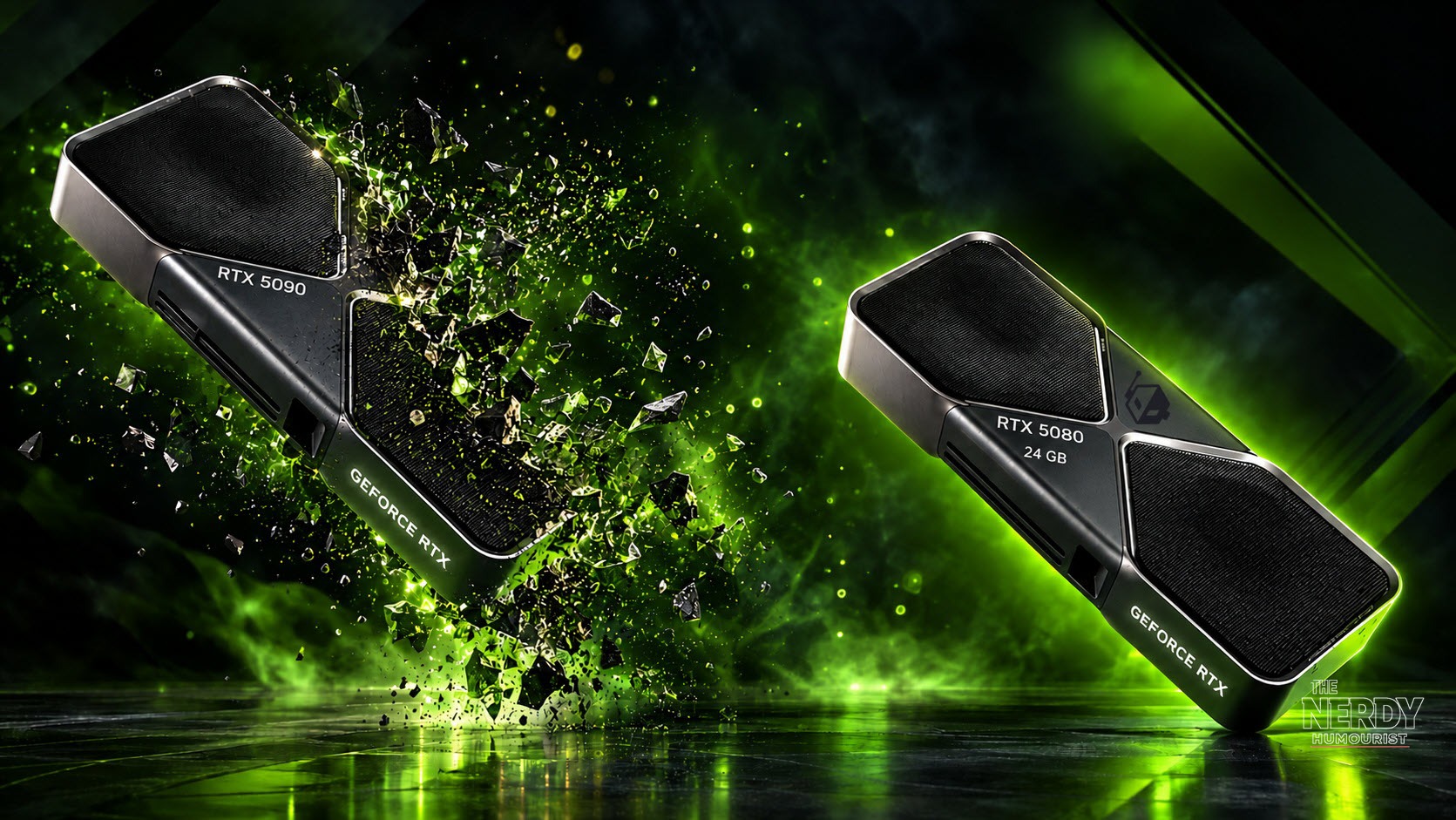
New reports claim Nvidia has quietly discontinued the GeForce RTX 5090, redirecting every future GB202 die to its professional RTX Pro lineup amid a deepening AI chip shortage. If the RTX 5090 discontinued reports are accurate, the $1,999 flagship that launched in January 2025 would end its retail life not with an announcement, but with a whisper — while third-party sellers are already asking close to $9,500 for the card.
Before going further, the essential caveat: this remains an unconfirmed rumor. Nvidia has made no public statement, and no board partner — not ASUS, MSI, or Gigabyte — has confirmed any production change. What follows is what the leakers claim, what the retail data actually shows, and why the economics make the rumor uncomfortably plausible.
Is the RTX 5090 Discontinued? What the Reports Actually Say
The claim surfaced on October 10, 2026, when hardware leaker Jukan posted on X that “the RTX 5090 has been discontinued” and that GB202 silicon would now be “supplied exclusively to the RTX Pro lineup.” VideoCardz picked up the post within hours, and outlets including Notebookcheck, Wccftech, HotHardware, and HWBusters ran versions of the story through the day.
Separately, leakers MEGAsizeGPU and hongxing2020 pointed to an alleged factory notice stating that Nvidia will no longer manufacture any RTX 5090 models — including the D variants sold in China. According to that alleged notice, the highest-end GeForce card going forward would be a new RTX 5080 24GB, while the existing RTX 5080 16GB gets retired. MEGAsizeGPU put the core claim bluntly: “All future GB202 supplies are RTX Pro exclusive.”
None of these outlets have independent confirmation from Nvidia, and no leaked document seen so far includes quantified production-cut figures. As Tech Insider noted in its own deep dive into the reports, the most defensible characterization is an unverified supply-allocation rumor layered on top of an already documented and severe shortage.
Why the RTX 5090 Discontinuation Rumor Makes Business Sense
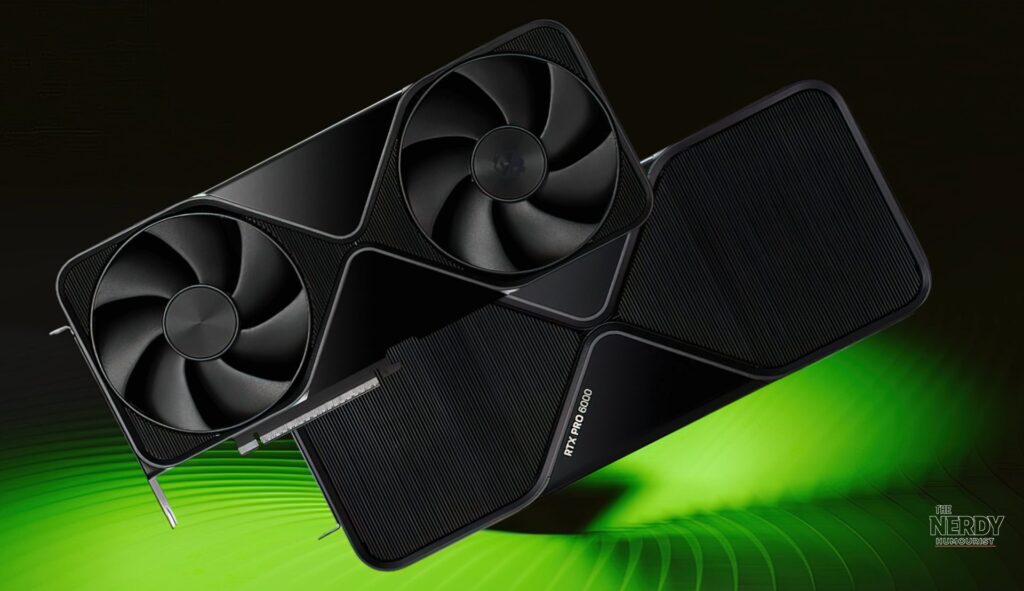
The plausibility of the rumor comes down to one chip: GB202. It is the full-fat Blackwell die inside the RTX 5090 — 21,760 CUDA cores, 32GB of GDDR7 — and it is also the silicon, binned differently, that powers Nvidia’s RTX Pro 6000 Blackwell workstation card with 96GB of memory.
Now look at the money. The RTX 5090 launched at $1,999. The RTX Pro 6000 launched in April 2025 at $8,565 and, according to Wccftech’s tracking, reached roughly $16,000 by August 2026 — nearly double its launch price with no hardware changes. Every GB202 wafer Nvidia steers away from GeForce and into RTX Pro is a wafer that earns dramatically more per die. Even Nvidia’s other GB202-based professional cards — the 84GB RTX Pro 5500 and the 72/48GB RTX Pro 5000 — sit far above consumer pricing.
Memory costs sharpen the math further. German outlet PC Games Hardware estimates the RTX 5090’s 32GB of GDDR7 costs roughly $320 at current component pricing, about 16% of the card’s $1,999 MSRP, citing TrendForce analysis. When the same die can sell in a $16,000 workstation card instead, the margin case for prioritizing RTX Pro only strengthens as component costs rise. Nvidia’s broader financial priorities have also shifted: the company has increasingly centered AI and data-center products in its earnings commentary over the past two years, and its record $150 billion buyback shows where its confidence — and cash flow — actually sits.
From $1,999 to $9,500: The RTX 5090’s Retail Meltdown
Whatever Nvidia decides internally, the retail picture already looks like a card being phased out. First-party US retailers — Newegg, Amazon, Best Buy, and B&H — currently show no first-party RTX 5090 stock, according to Ground News reporting. A September 14 retail check found the cheapest available listing at $6,395 on Amazon’s marketplace, while Newegg listings reached $8,699.
An October 7 price tracker run by Capital and Compute put the RTX 5090’s marketplace floor at $7,199.99 — roughly 260% above MSRP — with third-party sellers asking as much as $9,500. The RTX 5080, the next card down the stack, isn’t faring much better: its lowest tracked price sits at $1,653.99 against a $999 MSRP, a 65.6% markup.
Demand pressure is no longer just gamers versus scalpers. AI server builders have reportedly started buying retail RTX 5090 cards in bulk for local AI inference, drawn by the card’s price-to-performance ratio compared to data-center hardware. And the squeeze is spreading: US system integrator Stince Built warned in October that GPU prices are expected to climb “significantly,” with supply constraints tightening across its distribution partners. Wccftech has separately reported that China-based buyers are retrofitting thousands of smuggled 5090s with modified coolers and PCBs for AI workstation use, despite the existence of export-compliant variants like the RTX Pro 6000D and RTX 5090D V2, which carry locked features and reduced AI compute. The memory shortage behind all of this is the same one driving Micron’s record AI memory backlog — and it isn’t easing.
A Rumored RTX 5080 24GB Could Become the New Gaming Flagship
If the RTX 5090 is truly on its way out, the alleged factory notice names a successor: an RTX 5080 24GB that would become the ceiling of the GeForce lineup, replacing the current 16GB model rather than the 5090 itself.
Wccftech’s reporting frames the card as Nvidia’s planned consolation for gamers, using denser 3GB GDDR7 modules instead of the 2GB modules on the existing 16GB card, on the same 256-bit bus. The outlet estimates the 24GB model could land between $1,999 and $2,999, against the $1,499–$1,999 street prices of the current 16GB card. It would be a meaningful VRAM bump for creators and gamers running memory-hungry workloads — but still well short of the RTX 5090’s 32GB.
Treat this detail with the same caution as the rest of the story. No roadmap, launch date, or pricing for an RTX 5080 24GB has been confirmed by Nvidia, and leaks about memory-configuration changes to existing dies have a mixed track record.
What the Rumor Means for Gamers, Creators, and AI Builders
For PC gamers hoping to buy an RTX 5090 near its original price, the practical message is already clear regardless of the rumor’s truth: the card is functionally unobtainable at MSRP, and the channel shows no sign of restocking. If GB202 truly stops flowing to GeForce, remaining AIB inventory will simply sell through, and secondary-market prices will likely climb further. Micro Center remains one of the few outlets with limited in-store stock in the US.
Content creators and 3D artists face the same squeeze on 32GB of VRAM, with nothing below the professional tier offering equivalent capacity. The rumored RTX 5080 24GB would soften that blow if it materializes — but it remains, like everything else here, unconfirmed.
Board partners sit in an odd middle position: ASUS, MSI, and Gigabyte earn margin assembling and selling finished RTX 5090 cards, so a supply cutoff would shrink their highest-margin consumer product at a moment when demand is at its peak. That none of them has publicly confirmed the change suggests either that Nvidia hasn’t formally communicated an end date — or that partners are unwilling to get ahead of an official announcement.
Competitors, meanwhile, have no direct answer at this tier. As Tech Insider’s coverage notes, AMD’s Radeon lineup focuses on the mid-range and upper-mid-range, and Intel’s Arc lineup hasn’t attempted to challenge Nvidia at the $2,000-plus tier. Buyers who need top-tier performance have few alternatives beyond the used market for prior-generation Nvidia hardware.
RTX 5090 Discontinued: Frequently Asked Questions
Q: Is the RTX 5090 officially discontinued?
A: No. As of October 12, 2026, Nvidia has not confirmed any production stop, and no board partner has issued a statement. The discontinuation claim comes from hardware leakers and an alleged factory notice, relayed by outlets including VideoCardz, Wccftech, and Notebookcheck. Treat it as an unconfirmed rumor.
Q: Why would Nvidia kill its gaming flagship?
A: According to the reports, economics: the same GB202 die that goes into a $1,999 GeForce card also powers the RTX Pro 6000 workstation card, which now lists near $16,000. Diverting silicon to the professional lineup multiplies revenue per wafer many times over, especially as GDDR7 costs climb.
Q: What would replace the RTX 5090 for gamers?
A: The alleged factory notice points to a rumored RTX 5080 24GB becoming the top GeForce card, with the existing 16GB RTX 5080 retired. No specs, pricing, or launch date have been confirmed by Nvidia.
Q: Should I buy an RTX 5090 right now?
A: At current marketplace prices — roughly $7,200 to $9,500 against a $1,999 MSRP — the card is trading at workstation-level prices. With no official word on production or a successor, buyers are paying a steep premium for a card whose future is uncertain.

Leave a Reply
You must be logged in to post a comment.