
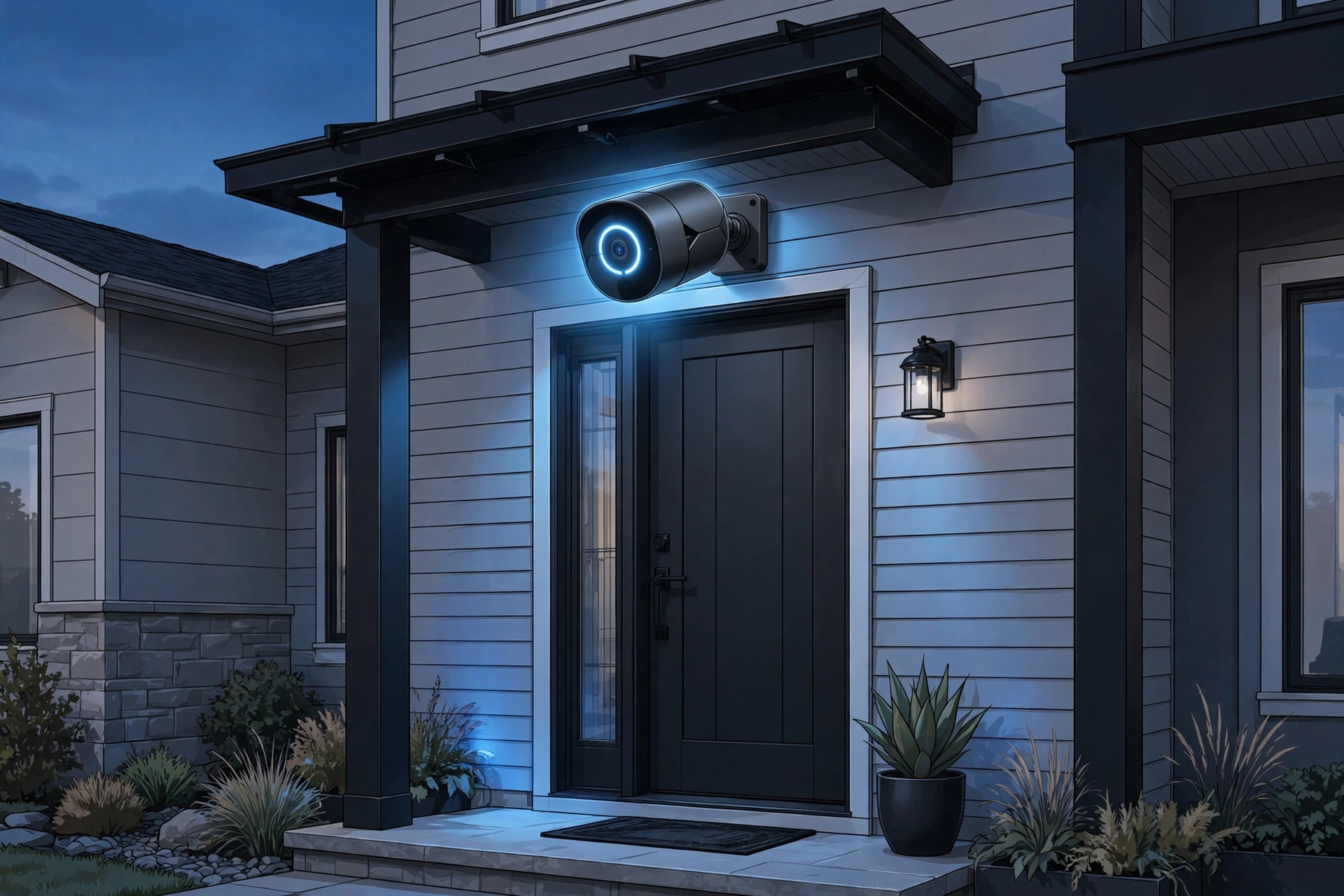
The AI home security camera race between Apple, Google, and Amazon is officially on. This month, all three giants have pushed major AI upgrades into their camera platforms — turning generic “motion detected” pings into plain-language descriptions of exactly what is happening at your front door. Each company’s AI home security camera play takes a different route, but the destination is the same: a camera that understands what it sees.
Apple’s move arrived with the public release of iOS 27 and tvOS 27. The new “Apple Intelligence for Home” adds AI-generated video summaries to HomeKit Secure Video, giving users short text descriptions of what compatible cameras captured instead of forcing them to scrub through clips. It also brings a natural-language video search feature and the ability to stitch footage from multiple cameras into one clip, according to MacRumors.
But Apple’s version comes with a catch that has drawn sharp criticism: the price. Apple Intelligence features require a 2TB iCloud+ plan — $9.99 a month — and that tier only covers a single camera. Two cameras require the $29.99-per-month 6TB plan, and AI summaries for up to five cameras demand the $59.99-per-month 12TB plan, MacRumors reported. Apple is not offering a plan that covers an unlimited number of cameras. Forums lit up with complaints, and one outlet calculated that an Apple One Premier household wanting AI on five cameras would pay an extra $60 a month — over $1,200 a year.

Google’s Gemini for Home Goes Further Into the Camera
Google’s answer is Gemini for Home, which launched in early access in October 2025 and replaced Google Assistant across Google’s smart home cameras, speakers, doorbells, and displays. According to Engadget, the biggest recent change is the ability to use Gemini to create automations triggered by what the cameras actually see — “anything your camera can see can now become the trigger that choreographs your entire home,” Google says.
The camera upgrades build on natural-language event descriptions that turn “motion detected” into alerts like “person approaching front door” or “dog lying on patio,” plus zoomed-in animated previews that crop toward the detected subject. Google also offers an “Ask Home” video search — users can ask what happened to the vase in the living room — and a “Home Brief” that condenses a day’s footage into a digestible summary, per CNBC TV18‘s coverage of the launch.
Google paired the software with new hardware: the Nest Cam Indoor (3rd gen), Nest Cam Outdoor (2nd gen), and Nest Doorbell (3rd gen), all with 2K HDR video. The cameras start at $99.99, $149.99, and $179.99 respectively. Notably, the devices include intelligent alerts for people, vehicles, animals, and packages, and video is encrypted by default with a visible green LED indicating when recording is active.
Amazon’s Ring Leans on Community AI
Amazon, meanwhile, has been pushing its Ring cameras toward what it calls community AI. Announced at CES 2026, the headline feature is AI Unusual Event Alerts: instead of notifying you about every passing car or swaying branch, Ring cameras learn what is normal around your home and flag only genuinely anomalous activity, according to TechCrunch.
Ring’s software uses Video Descriptions to understand what is happening in each clip, surfacing specific warnings based on location, actions, and even clothing. A related feature, Active Warnings, lets cameras automatically play a context-aware spoken deterrent when they detect a person approaching — with a live human guard reviewing the situation for Virtual Security Guard subscribers, per Android Authority.
Amazon also leaned into the neighbor-network angle. Its “Search Party” feature lets nearby Ring cameras scan for a lost dog when an owner files a report through the Ring Neighbors app, and the company added Fire Watch — community-based wildfire detection built into the Neighbors section. Ring’s Pro-tier AI features, including Video Descriptions, Familiar Faces, and video search, have been consolidated under the renamed Ring Pro subscription.
AI Home Security Camera Showdown: Three Strategies, No Cross-Compatibility
The striking thing about this race is how locked-in each lane is. Apple’s intelligence runs on HomeKit Secure Video cameras and its own subscription ladder. Google’s works with Nest cameras and the Google Home ecosystem. Amazon’s works with Ring hardware and its Neighbors network. There is no cross-compatibility between them, so choosing a camera is effectively choosing — or being locked into — a smart home platform.
Pricing philosophies differ sharply. Apple tied its features to expensive iCloud+ storage tiers, a move many observers called a price gouge on a single camera for $9.99 a month. Amazon and Google have bundled comparable AI features — video descriptions, smart alerts, search — into subscriptions that generally run around $20 a month for their ecosystems, making Apple’s up-to-$60 pricing an outlier.
Privacy is another dividing line. Apple’s HomeKit Secure Video has long emphasized end-to-end encryption and on-device processing, a posture it carried into the new summaries. Google emphasizes encryption by default and visible recording indicators. Ring, which has faced years of scrutiny over police partnerships and data access, has responded with features like TAKE encryption and a decision to drop a planned integration with Flock Safety’s license-plate cameras after surveillance concerns were raised, according to TechRepublic.
What This Means for Shoppers This Fall
For consumers, the practical takeaway is that the era of the “dumb” motion alert is over. If you are buying a camera this fall, the question is no longer megapixels — all three companies offer high-resolution sensors and HDR — but which assistant’s brain you want interpreting the footage. Apple’s pitch is privacy-first intelligence with an ecosystem you likely already pay for; Google’s is the most ambitious about turning camera events into automations; Amazon’s is the most community-oriented, turning neighbors’ cameras into a shared safety net.
The costs are still settling. None of the three has made the flagship AI features free, and the best capabilities in every ecosystem sit behind subscriptions. As Apple rolls out its camera intelligence alongside the new iPhone Duo foldable and the broader iOS 27 wave, the smart home camera has become the most contested gadget of the season — and the most expensive to keep smart.

AI Home Security Cameras: FAQs
Q: What is Apple Intelligence for Home?
A: Apple’s AI upgrade for HomeKit Secure Video, released with iOS 27 and tvOS 27. It adds AI-generated video summaries, natural-language video search, and multi-camera clip stitching to compatible home security cameras. It requires a 2TB iCloud+ plan ($9.99/month) for a single camera, rising to $59.99/month for up to five, according to MacRumors.
Q: What can Google’s Gemini for Home do with cameras?
A: Gemini for Home turns camera events into natural-language alerts like “person approaching front door,” offers zoomed-in animated previews, lets users search video history with plain-language questions, and can trigger smart home automations based on what cameras see, according to Engadget and CNBC TV18.
Q: What are Ring’s AI camera features in 2026?
A: Ring offers AI Unusual Event Alerts that flag only anomalous activity, Video Descriptions that narrate what is in each clip, Active Warnings that play spoken deterrents, Familiar Faces recognition, and community features like Search Party for lost pets and Fire Watch for wildfire detection, according to TechCrunch and Android Authority.
Q: Do these AI camera features work across Apple, Google, and Amazon?
A: No. Each company’s AI features are locked to its own ecosystem and subscription — HomeKit Secure Video for Apple, Nest and Google Home for Google, and Ring for Amazon — with no cross-compatibility.
