

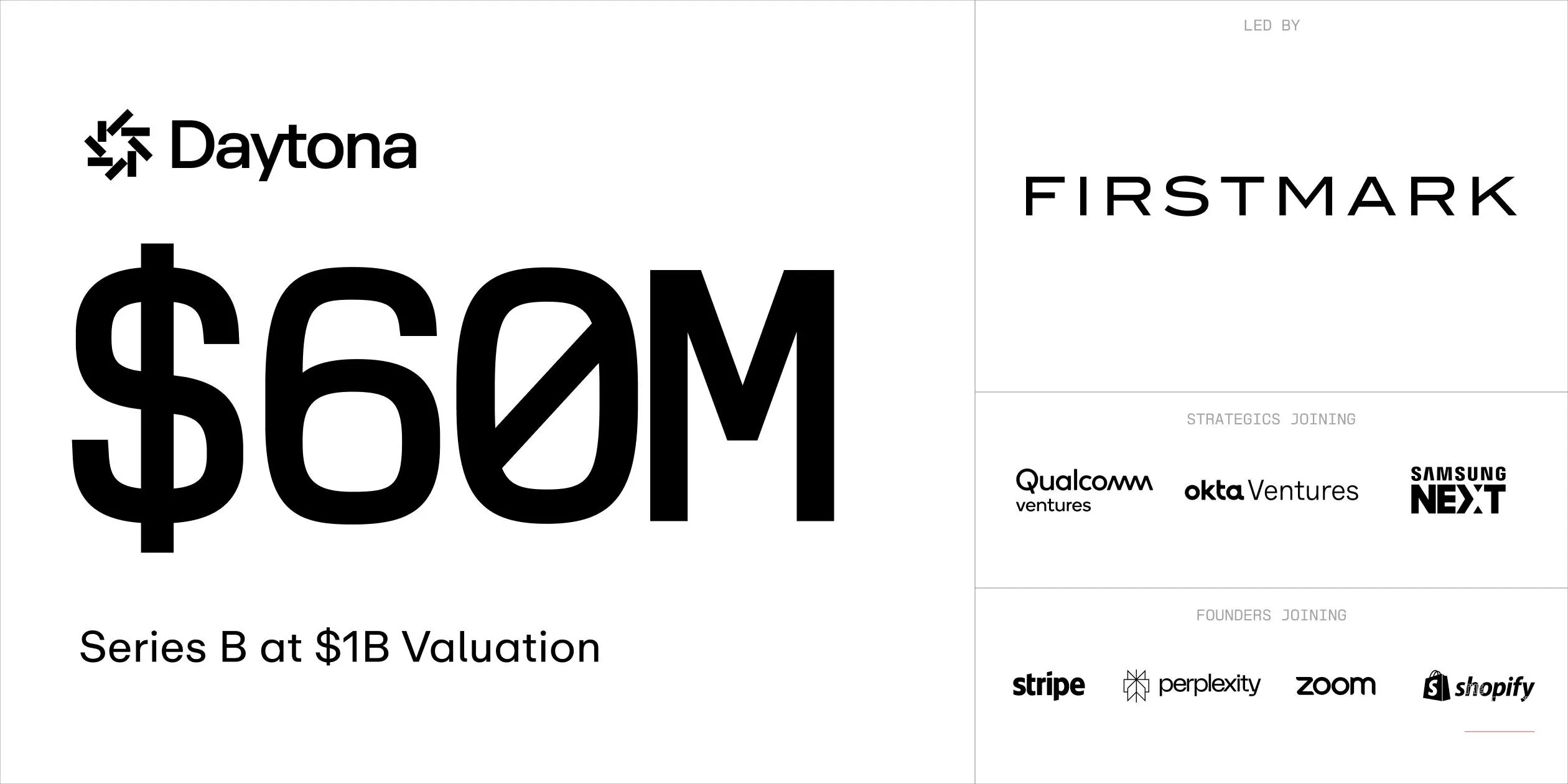
Daytona, a three-year-old startup building a cloud designed specifically for AI agents, has raised $60 million in a Series B round at a $1 billion valuation, becoming the latest unicorn minted by the AI agent boom. The round, announced on October 20, 2026, and led by FirstMark Growth, brings the company’s total funding to $91 million — and the investor list reads like a roll call of the tech industry’s most prominent founders.
The Daytona agent cloud pitch is simple: AI agents are digital workers, and like any worker, each one needs its own computer. Traditional cloud infrastructure was built for long-running services used by humans. Agents behave differently — they spin up thousands of short, stateful jobs nobody planned in advance — and Daytona argues they need a cloud built for that reality.
The round and the investors
Daytona Platforms announced the $60 million Series B on Friday, October 20, 2026, according to the company’s own blog post, with TechCrunch reporting the round on October 23. FirstMark Growth led the round, having also led Daytona’s $24 million Series A in February 2026. About $50 million of the new $60 million came from existing investors, according to reports of the deal — a conviction signal that costs those backers real money.
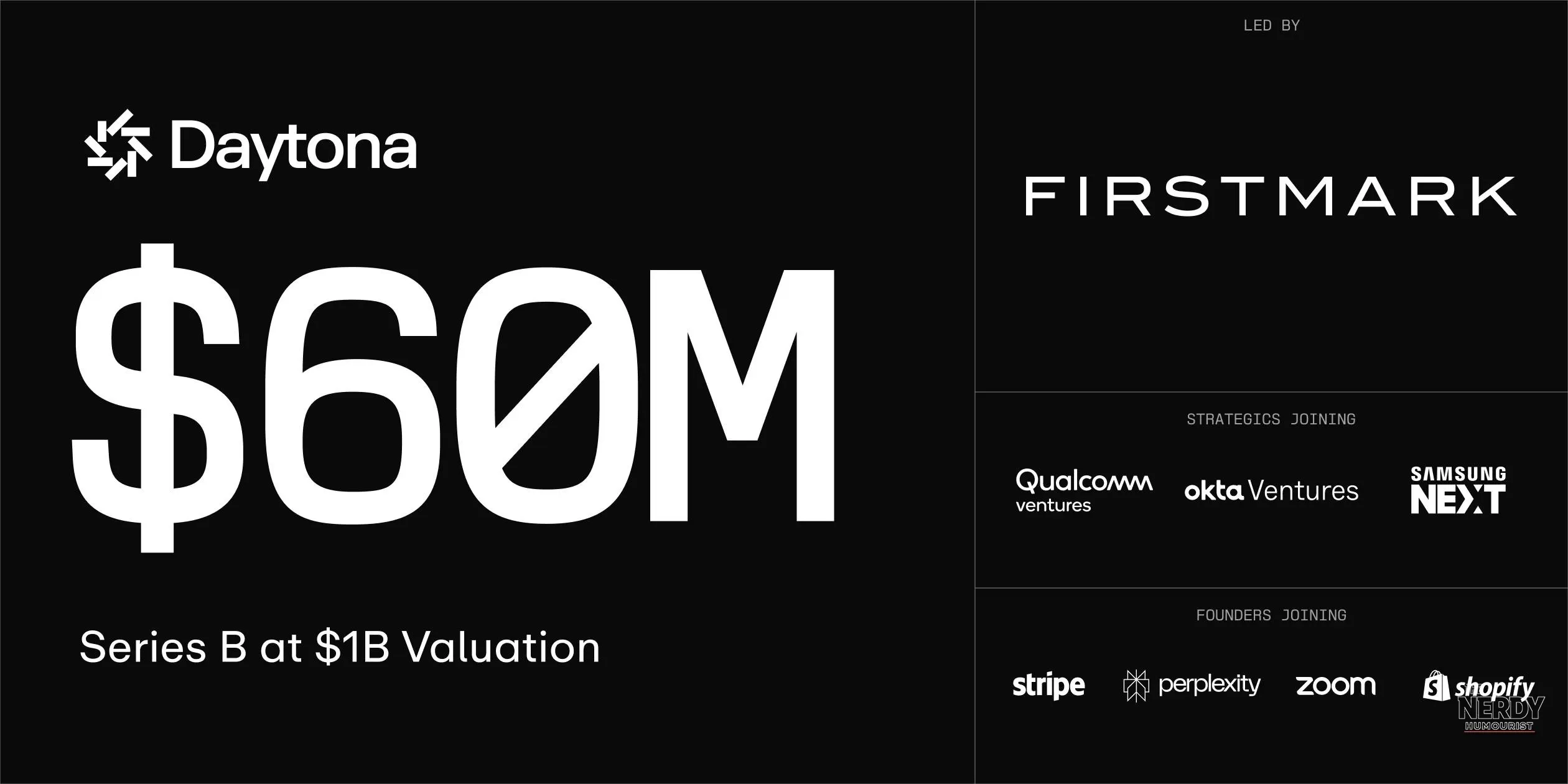
The angel list is unusually star-studded. Daytona names Stripe co-founder Patrick Collison, Shopify CEO Tobi Lütke, Perplexity CEO Aravind Srinivas, Zoom founder Eric Yuan, Datadog CEO Olivier Pomel, Quora CEO Adam D’Angelo — who is also an OpenAI board member — and Mercor CEO Brendan Foody. Strategic investors Qualcomm Ventures, Samsung Next and Okta Ventures also joined, alongside Alumni Ventures, Evergreen Fund and Torch Capital. Existing backers increased their positions substantially: Pace Capital doubled its investment, Upfront Ventures tripled its stake, and E2VC quadrupled theirs, according to Tech.eu’s coverage.
Daytona is based in New York and was founded in 2023 by chief executive Ivan Burazin, chief architect Goran Draganić and chief technology officer Vedran Jukić. Burazin previously co-founded the cloud coding tool Codeanywhere in 2011, founded the Shift developer conference, and served as chief developer experience officer at Infobip — a long history in developer tools that predates the current agent wave by more than a decade.
What the Daytona agent cloud actually does
At its core, Daytona provides secure, isolated computing environments — sandboxes — where an AI agent can execute code, call tools, browse the web and manage workflows on its own. The company’s broader platform, which it calls the Agent Cloud, is the execution layer for agents: computers, browsers, storage and anything else an agent needs to do its job. It is not, the company stresses, inference, observability, or a management dashboard.
“Agents don’t work like the long-lived services today’s cloud was designed for. They spin up thousands of short, stateful jobs nobody planned in advance, and they need a cloud built for that,” founder Ivan Burazin wrote in the blog post announcing the round. Daytona’s cloud, he said, is like giving every agent its own computer, with access to sandboxed versions of Linux, Windows, macOS and GPUs on one platform.
The technical differences from a conventional cloud instance are the heart of the pitch. A traditional instance takes minutes to boot and runs until someone shuts it down. An agent’s computer, Daytona says, has to start in milliseconds, pause with its state intact, fork into parallel copies to try several approaches at once, and disappear when the job is done. Daytona says its sandboxes provision in milliseconds, and one analysis of the round cited a 60-millisecond boot time.
The multi-operating-system support is a genuine differentiator: an agent can optimize a CUDA kernel, test a native Mac app, drive a Windows desktop, or work in 3D CAD software without leaving the platform.
The growth numbers behind the valuation
Daytona says demand has accelerated sharply as long-running agents have moved into production. Since January 2026, the company’s revenue has grown approximately 25-fold, with average month-over-month net revenue retention of approximately 135% — meaning customers from six months ago are, in aggregate, spending nearly three times as much today, according to the company’s blog post.
The customer list spans the agent stack. Model builders such as Meta and Cohere use the platform, as do the teams creating data and environments that train the next generation of models, including Handshake, Snorkel, Surge AI, Turing, AfterQuery and Trajectory. Companies putting agents to work in products people use every day include Writer, Clay, n8n, Postman, Mintlify and Bolt.new. Daytona also says it provides infrastructure to Anthropic, OpenAI, NVIDIA, Cursor and Cognition.
One customer story illustrates why the category is scaling: Writer ran its own sandbox platform until it passed 20,000 sandboxes a day; on Daytona, it provisioned 300,000 sandboxes in a single month, according to Daytona’s account.
What Daytona has not disclosed is absolute revenue. A 25-fold growth rate is impressive, but without a starting figure it cannot be converted into a revenue number, and no independent audit of the growth claims has been published. That gap is worth noting: a $1 billion valuation is a vote of confidence from investors, not a finished result, and valuations in the agent-infrastructure space can move fast in both directions.
Why investors are betting on agent infrastructure
The Daytona round is part of a wider land grab for the infrastructure layer of the agentic economy. As AI systems move beyond answering questions to performing tasks autonomously — writing code, operating software, running experiments — companies face growing infrastructure demands. Running large numbers of agents simultaneously requires computing resources that scale with demand while keeping each agent securely isolated from the others.
“Companies are going to manage thousands of digital employees, and each one needs a safe place to fail,” Burazin said, according to Tech.eu’s coverage. “Daytona ensures one rule breaking agent doesn’t spill into company wide chaos.” That security framing matters: an agent with access to code execution, browsers and internal tools is a far larger attack surface than a chatbot, and a sandbox breach could cascade across a company’s systems.
The strategic investors map neatly onto that thesis. Qualcomm Ventures brings chip-level relevance, Samsung Next brings device and hardware distribution, and Okta Ventures brings identity and access management — three pieces of the puzzle for running agents safely at scale.
With the new funding, Daytona plans to expand beyond its sandbox product, scale its computing infrastructure, and hire in San Francisco, Croatia and Singapore.
What could go wrong
The risks are real and worth stating plainly. The market for AI agents is crowded, and the large cloud providers — Amazon, Microsoft and Google — are not standing still; any of them could build agent-native primitives into their existing clouds and undercut a standalone provider. Daytona’s differentiation rests on speed, multi-OS breadth and developer experience, advantages that are defensible but not unassailable.
There is also the question of durability. Much of the current agent boom is driven by experimentation budgets, and if agent deployments consolidate around a few dominant platforms, infrastructure spending could concentrate with them. Daytona’s revenue retention figures suggest its customers are expanding rather than churning, but those figures are self-reported and cover a period of explosive growth.
Still, the round’s structure — insiders funding most of it, strategics joining, and founders of category-defining companies writing personal checks — is a stronger signal than a headline valuation alone. Burazin has been building in this space for fifteen years, from Codeanywhere to Daytona, and the agent cloud thesis that once looked contrarian is now consensus. Whether Daytona becomes the default execution layer for agents or a feature inside someone else’s cloud is the question the next two years will answer.
Frequently asked questions
What is the Daytona agent cloud?
Daytona’s Agent Cloud is infrastructure that gives each AI agent its own secure, isolated computer — a sandbox running Linux, Windows, macOS or GPU workloads — that starts in milliseconds, can pause and resume with its state intact, fork into parallel copies, and disappear when the job is done.
How much did Daytona raise and at what valuation?
Daytona raised $60 million in a Series B round at a $1 billion valuation, led by FirstMark Growth. The round, announced October 20, 2026, brings Daytona’s total funding to $91 million, following a $24 million Series A in February 2026.
Who invested in Daytona’s Series B?
FirstMark Growth led the round. Angel investors include Stripe’s Patrick Collison, Shopify’s Tobi Lütke, Perplexity’s Aravind Srinivas, Zoom’s Eric Yuan, Datadog’s Olivier Pomel, Quora’s Adam D’Angelo and Mercor’s Brendan Foody. Qualcomm Ventures, Samsung Next and Okta Ventures joined as strategic investors.
Why do AI agents need their own cloud?
Agents spin up thousands of short, stateful jobs that traditional cloud instances — designed for long-running human-operated services — handle poorly. Agents need environments that start in milliseconds, retain state, fork into copies and shut down cleanly, with strong isolation so one misbehaving agent cannot affect others.
Internal link: For more on the agent wave, see our earlier coverage: Claude Duet: Anthropic’s AI Agent App. Outbound sources: TechCrunch: Daytona hits $1B valuation, Daytona blog: $60M Series B announcement.


Leave a Reply
You must be logged in to post a comment.