

The Dow Jones Industrial Average fell 1,101 points on Thursday. The Dow sinks 1101 points to 49,097.06, its first close below 50,000 since early June — and the S&P 500 fell for a sixth straight session, its longest losing streak since April 2024.
It was a strange day to lose that much money. The morning started with a party. Anthropic, the AI lab behind the Claude chatbot, made its stock market debut after the biggest initial public offering in history, and shares jumped 34% out of the gate. By the close, the debut was a footnote and the sell-off was the story.
More than 90% of the stocks in the S&P 500 fell, according to the Associated Press reported. The losses were that broad. The Dow has now shed 2,500 points in just three sessions.
Dow sinks 1101 points: the numbers
The Dow dropped 1,101.11 points, or 2.19%, to close at 49,097.06. The S&P 500 fell 147.80 points, or 2.02%, to 7,175.83. The Nasdaq composite sank 550.69 points, or 2.25%, to 23,879.20. The Russell 2000, which tracks smaller companies, lost 2.18% to 2,655.11.
That S&P 500 close puts the index 8.2% below the all-time high it set last month. Six straight down days is the longest slide since April 2024. The Nasdaq, meanwhile, was up 2.1% at its morning high and traded in a range of more than four percentage points before finishing down — a swing that tells you how jumpy the market was.
Wall Street’s fear gauge felt it too. The Cboe Volatility Index, the VIX, jumped 15.8% to 28.44, according to the Wall Street Journal. Anything above 20 signals real nerves. At 28, the market was pricing in a lot more turbulence ahead.
The bond market told the same story in reverse. Investors moved toward safety, pushing Treasury prices up and yields down. The yield on the 10-year Treasury fell to 5.04% from 5.07% on Wednesday. A couple of economic reports that came in weaker than expected didn’t help — slightly more Americans applied for unemployment benefits last week, and manufacturing growth in the mid-Atlantic region slowed more than economists had forecast.
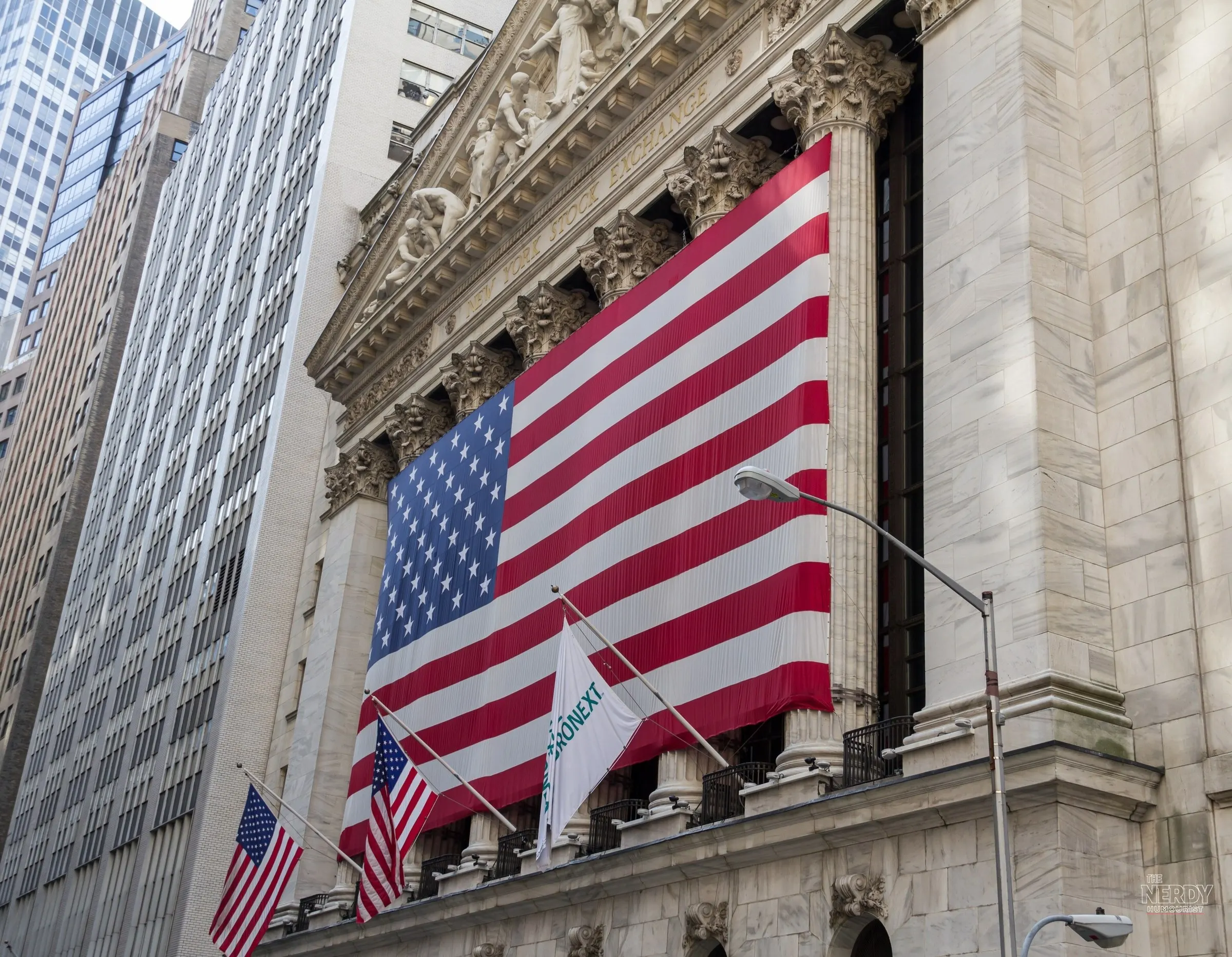
Anthropic’s debut couldn’t save the day
Anthropic was supposed to be the good news. Anthropic priced its shares at $83, above the $70 to $78 range it had first talked about, raising about $81 billion — the largest IPO ever. When trading opened on the Nasdaq shortly before noon, the price shot above $115.
For a while, it worked. The S&P 500 jumped as much as 1.3% in the morning, and several AI stocks rallied hard. Micron Technology, whose memory chips have ridden the AI boom, climbed 7.8%. CoreWeave, which rents out AI chip capacity over the cloud, leapt 10.5%. Nvidia gained 4.7% early.
Then the whole thing unwound. Anthropic gave back most of its gain and finished at $97.17 — still up 17.1% from its $83 offering price, but a long way from where it started. Micron swung to a 2.1% loss. CoreWeave ended down 6.1%. Nvidia erased its early gain and flipped to a 3.3% loss, closing at $145.98.
The pattern was the same across the board: a morning rally built on IPO excitement, then a steady afternoon slide as the old worries came back. Dan Ives, an analyst at Yorkville Ives, called it “a very turbulent, white-knuckle period” for AI stocks. He wasn’t exaggerating. The tech-heavy SPDR Select Sector Technology fund closed down 1.9% and is now more than 20% below its October peak — bear-market territory for the sector that carried the whole market higher this year.
Dow sinks 1101 points: why sellers took over
No single headline caused Thursday’s drop. It was a pile-up, and the AP’s account of the day lists the worries in the order they arrived.
First came the bubble question. AI stocks shot up so fast this year that plenty of investors now wonder whether the prices got ahead of the profits. The spending on data centres is enormous, and the returns are still mostly a promise. Second came interest rates — high borrowing costs make it harder to fund that spending. Then came this month’s sweeping Democratic victories in the midterm elections, which raised concerns about tighter regulation for AI. And most recently, Jensen Huang suddenly resigned as Nvidia’s chief executive, removing one of the industry’s loudest cheerleaders just as doubts were building.
Put together, that’s a lot of reasons to sell. And sell they did — across almost every sector.
The damage wasn’t limited to AI names. Williams-Sonoma led the S&P 500 downward, dropping 15.2% after the company behind Pottery Barn and West Elm reported quarterly revenue a bit weaker than Wall Street expected — and stuck with a full-year forecast whose midpoint came in below analysts’ estimates. Walmart sank 1% even though its profit and revenue edged past expectations. When a retailer beats estimates and still falls, you know the mood.
There were a few bright spots. Palo Alto Networks climbed 6.4% after topping profit and revenue expectations and agreeing to buy Applied Compute, a platform for post-training and inference of open-weight AI models, in an all-stock deal valued at $4.5 billion. Everpure, which helps businesses manage and store data, rose 4.7% after its revenue jumped more than expected, helped in part by AI-related offerings. But two winners don’t make a market.
How the week got here
Thursday was the worst day of a bad stretch, not a bolt from the blue. The Dow fell 849 points on Wednesday, and Investopedia reported the index has now lost 2,500 points over the last three sessions alone. The S&P 500’s six-day slide is the longest since April 2024, back when tariff fears rattled markets.
Overseas markets were mixed. Japan’s Nikkei 225 rose 0.7%, helped by SoftBank Group, which climbed 4.6% — SoftBank was an early investor in OpenAI, Anthropic’s rival. South Korea’s Kospi climbed 1.4% on strength in its AI-linked stocks. Germany’s DAX lost 1.1%, closer to the mood on Wall Street.
What comes next is the question nobody can answer with confidence. A six-day slide doesn’t have to become a rout — markets have bounced back from worse. But the pieces that drove Thursday’s selling haven’t gone away. The AI profit question is still open. Rates are still high. The regulation debate is just starting. And the VIX at 28.44 says traders expect more sharp moves, not fewer.
One thing is settled, though. The biggest IPO in history couldn’t stop the slide. If Anthropic’s debut — $81 billion raised, a $1.3 trillion market value at the close, shares up 17% — can’t steady the market for a single day, then the market’s problem isn’t a lack of good news. It’s a lack of belief in the story that carried it this far.

Frequently asked questions
How much did the Dow fall on Thursday? The Dow Jones Industrial Average fell 1,101.11 points, or 2.19%, to close at 49,097.06 on Thursday, November 19, 2026. It was the Dow’s first close below 50,000 since early June.
Why did the S&P 500 fall for a sixth straight day? Investors kept selling AI-related stocks on worries that prices ran too high, that AI profits won’t justify the huge spending on data centres, and that high interest rates and possible new regulation will squeeze the industry. Nvidia CEO Jensen Huang’s sudden resignation added to the unease.
Did Anthropic’s IPO help the market? Not for long. Anthropic opened at $111.50, 34% above its $83 IPO price, and the market rallied in the morning. But the stock faded to close at $97.17, still up 17%, and the broader market sold off in the afternoon anyway.
Is the market in a correction? Not quite. A correction means a 10% drop from a recent high. The S&P 500 is 8.2% below its all-time high from last month, and the Dow is close to that line too — but neither index has crossed it yet.


Leave a Reply
You must be logged in to post a comment.