
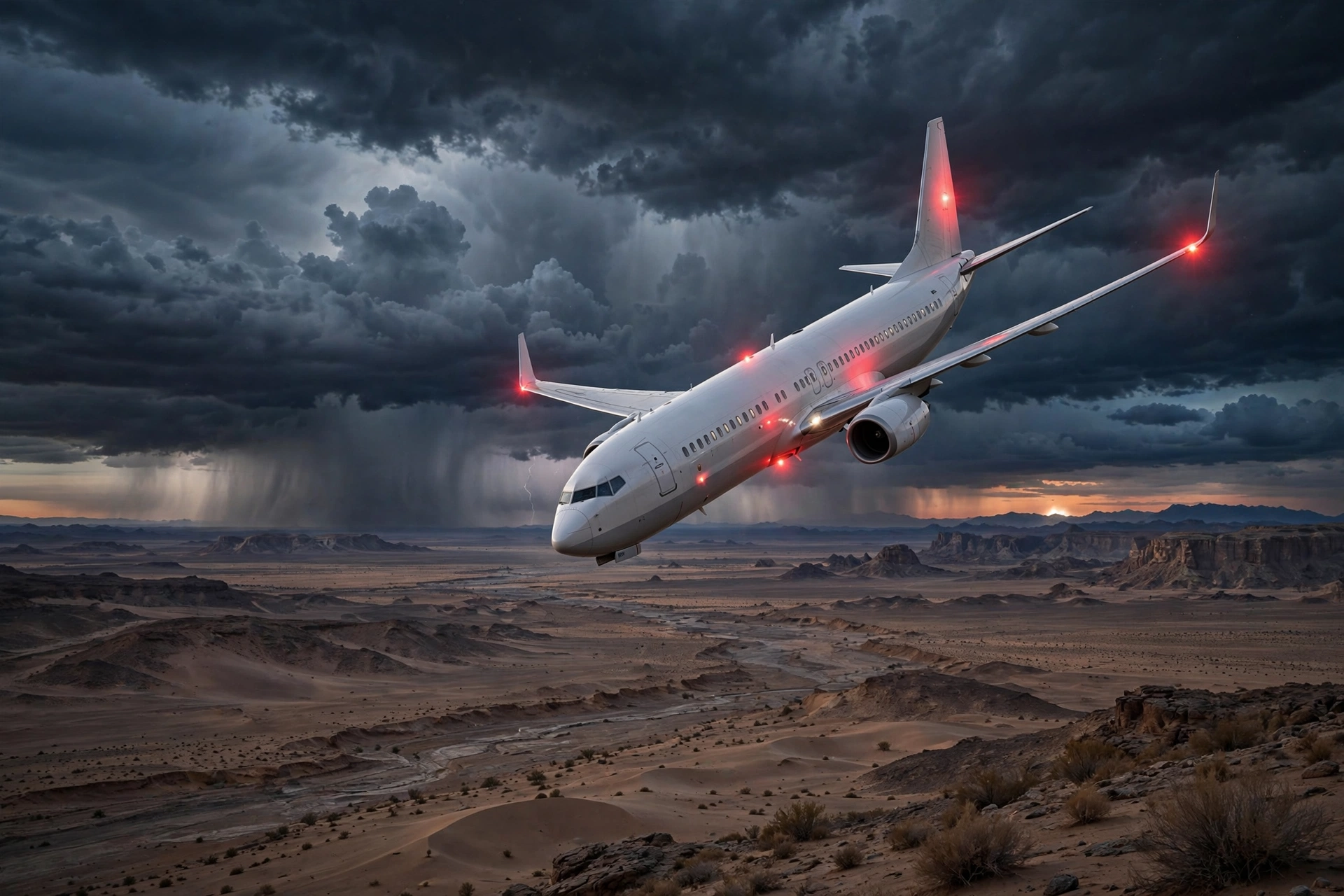
A FlyDubai passenger jet bound for Tel Aviv plunged more than 17,000 feet over Saudi Arabia on September 30 after a violent FlyDubai cockpit attack left one pilot stabbed and the aircraft in a steep, uncontrolled descent, officials and reports said. Flight FZ1073, traveling from Dubai to Tel Aviv, made an emergency landing at Tabuk Airport in northwestern Saudi Arabia, where both pilots were hospitalized.
According to CNN, the aircraft descended 17,400 feet — from 34,000 to around 16,600 feet — in just over two minutes at around 1:20 a.m. ET. The Boeing 737 MAX 8 transmitted a general emergency squawk code 7700, followed minutes later by squawk code 7500, the international code signaling unlawful interference or hijacking, flight-tracking data reviewed by CNN and Flightradar24 showed.
Israeli Prime Minister Benjamin Netanyahu said the co-pilot stabbed the captain and attempted to crash the aircraft. Citing a passenger account, Netanyahu said passengers and a crew member broke into the flight deck as the plane plunged and restrained the co-pilot, while other pilots aboard helped land the aircraft, according to USA Today.
What Happened Aboard FlyDubai FZ1073
Flight FZ1073 departed Dubai around 7 a.m. local time on September 30, headed for Tel Aviv with roughly 180 passengers aboard, most of them Israeli nationals. About two hours into the flight, as the plane crossed into Saudi airspace, a violent struggle broke out between the pilots in the flight deck.
A FlyDubai spokesperson said flight FZ1073 “experienced an incident while en route” and landed at Tabuk Airport, adding that all passengers were safe and accounted for. Tabuk airport officials said air traffic control received a distress call at 8:44 a.m. local time requesting an emergency landing; the aircraft touched down safely at 9:45 a.m., and both the captain and co-pilot were taken to a hospital for treatment.
Israeli media reported dramatic details of the fight to save the plane. According to USA Today, Netanyahu identified the captain as Captain Smit Machchhar, calling him “a true hero” after he reportedly resisted the attack long enough to open the cockpit door despite being stabbed and seriously injured, allowing passengers and crew to overpower the attacker.
President Donald Trump, citing Netanyahu, described how a passenger named Yaniv Hayoun helped level out the plane. “He took the stick, lifted it up, and leveled out the plane before it crashed,” Trump said of the Israeli plumber who, according to Netanyahu’s account, helped save the aircraft.

Terror Attack or Internal Dispute? Officials Divided
Exactly what happened inside the flight deck remains under investigation, and officials have not publicly established a motive. Netanyahu stopped short of calling it a terrorist attack. However, another Israeli official identified the co-pilot as an Omani national and described the incident as an attempted terrorist attack, while Israeli Defense Minister Israel Katz also called it an attempted terrorist attack, according to USA Today.
Israeli National Security Minister Itamar Ben-Gvir described the alleged attacker as a terrorist who “planned to crash a plane and murder the 180 Israelis on board,” the Qatar Tribune reported.
FlyDubai has so far described what happened only as an “incident,” and an Israeli official told CNN the incident was not a hijacking but rather an internal personnel incident aboard the aircraft. Saudi authorities were expected to question the co-pilot as the investigation continued.
Trump said earlier that his administration was weighing two possibilities: “It’s a nutcase or a jihadi.” White House counterterrorism chief Sebastian Gorka told Newsmax that U.S. aviation security measures put in place since 9/11 protect Americans from a repeat of such an attack on a U.S. carrier, saying, “The first reports from the battlefield are almost always wrong.”
Israeli Fighter Jets Scrambled, Security Consultation Held
The emergency codes prompted an immediate Israeli military response. Netanyahu and Defense Minister Israel Katz held a security consultation, and Israeli fighter jets were scrambled after the emergency signal was sent, an Israeli military spokesperson told CNN.
The emergency landing in Tabuk marked a rare mass arrival of Israelis in Saudi Arabia, a country that has no diplomatic relations with Israel. Saudi Arabia opened its airspace to Israel-bound flights and Israeli airlines in 2022 as part of a U.S.-brokered normalization push, but Riyadh says it will not establish full diplomatic relations without an independent Palestinian state.
Netanyahu’s office said “all measures are now being taken to safely return the Israeli passengers to Israel,” and Saudi airport officials coordinated with the airline to arrange a replacement aircraft for the stranded passengers.
Timing: Days Before Israeli Election
The incident comes just days before a closely watched Israeli election, and amid warnings from Netanyahu that Israel’s enemies could attempt attacks ahead of the vote. Netanyahu had warned that Israel’s “long arm” would reach anyone who attempted such attacks anywhere and at any time, according to The Economic Times.
The episode has also intensified the already volatile standoff between Israel and Iran. Earlier this week, Iran warned the United Arab Emirates of “highly dangerous consequences” after Netanyahu’s visit to Abu Dhabi, accusing Israel of expanding its military footprint in the Gulf. The FlyDubai attack — involving an Emirati airline, Israeli passengers, and a Saudi landing site — touches every fault line in the region at once.
For the latest on how regional tensions are playing out, read our report on Israel’s killing of a senior Hamas commander in a Gaza airstrike.
What Investigators Are Looking Into
Investigators from Israel, Saudi Arabia, and the United Arab Emirates are working to determine exactly what happened aboard the flight. Key unanswered questions include:
- What was the co-pilot’s motive, and had he shown any prior warning signs?
- How did the attacker gain the upper hand in the cockpit despite reinforced post-9/11 flight-deck doors?
- What role did off-duty pilots or crew aboard the flight play in landing the aircraft?
- Whether the incident was a premeditated act of terrorism or an isolated mental health episode.
Aviation experts say the case raises serious questions about insider-threat protocols in commercial aviation. Unlike hijackings by passengers, attacks by crew members are among the hardest threats to defend against — a point underscored by the Germanwings Flight 9525 disaster in 2015, when a co-pilot deliberately crashed an aircraft into the French Alps.
Gorka’s warning that “the first reports from the battlefield are almost always wrong” suggests U.S. officials are treating early Israeli accounts with caution until Saudi and Emirati investigators finish their work.

FAQ
What happened on FlyDubai flight FZ1073?
Flight FZ1073, traveling from Dubai to Tel Aviv on September 30, suffered a violent incident in the cockpit in which the co-pilot allegedly stabbed the captain, according to Israeli officials. The plane plunged more than 17,000 feet before landing safely at Tabuk Airport in Saudi Arabia. Both pilots were injured and hospitalized; all passengers survived.
Was the FlyDubai incident a terrorist attack?
That has not been officially established. Israeli Defense Minister Israel Katz and another Israeli official called it an attempted terrorist attack, and the co-pilot was identified as an Omani national. However, Prime Minister Netanyahu stopped short of that label, and FlyDubai has called it only an “incident.” The motive remains under investigation by Saudi, Israeli, and Emirati authorities.
Who saved the plane?
According to Israeli officials cited by USA Today, Captain Smit Machchhar — despite being stabbed and seriously injured — opened the cockpit door so passengers and crew could restrain the attacker, and a passenger named Yaniv Hayoun helped level the plane out of its steep descent. Both have been praised as heroes by Netanyahu and Trump.
Why did Israeli fighter jets scramble?
The aircraft transmitted squawk code 7500, the international signal for unlawful interference or hijacking, after first transmitting the general emergency code 7700. The 7500 signal triggered Israel’s air defense protocols, and fighter jets were dispatched toward the aircraft as a precaution, according to an Israeli military spokesperson.
Sources: USA Today, CNN, Newsmax. This is a developing story.

Leave a Reply
You must be logged in to post a comment.