
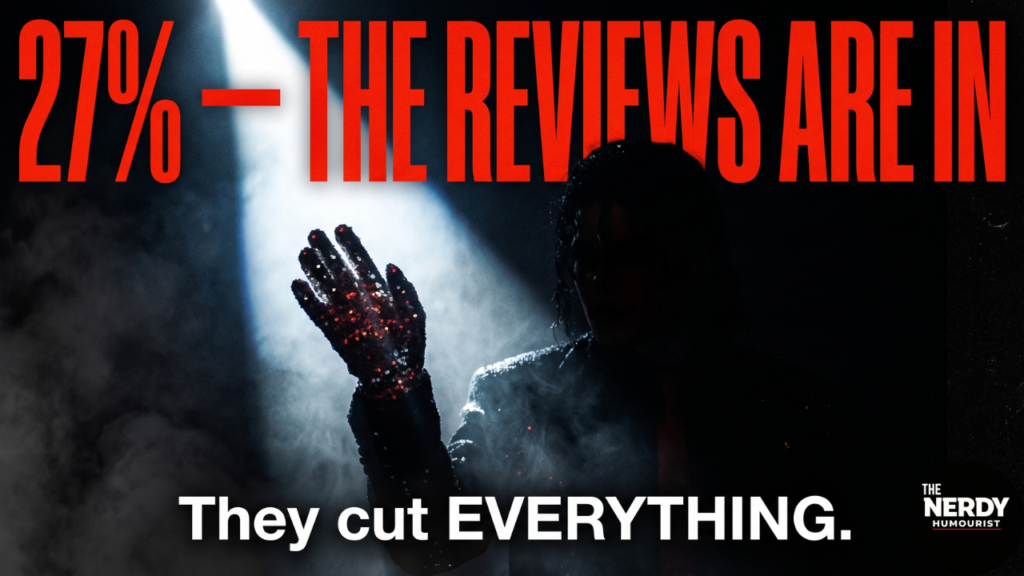
Hollywood gave the King of Pop a $150 million tribute. Critics gave it back at a fraction of the price. The Michael Jackson biopic, simply titled Michael, opened in theaters and IMAX worldwide on April 24, 2026 — and while fans flooded multiplexes, the critical response became one of the harshest receptions for a major studio release in recent memory. The film sits at just 27% on Rotten Tomatoes’ Tomatometer in early tallies, with critics’ scores ranging from the high 20s to the high 30s across different aggregations. The debate it sparked, though, goes far beyond star ratings.
The movie
Directed by Antoine Fuqua and written by John Logan, Michael stars Jaafar Jackson — Michael Jackson’s actual nephew — in the title role, supported by Nia Long as Katherine Jackson, Miles Teller as attorney John Branca, Oscar winner Colman Domingo as Joe Jackson, Kendrick Sampson as Quincy Jones, Kat Graham as Diana Ross, Juliano Krue Valdi as the young Michael, and Mike Myers in a cameo. The film traces Jackson’s arc from the Jackson 5 through his emergence as a solo phenomenon, and by most accounts Jaafar’s physical performance — the voice, the gestures, the stagecraft — is genuinely impressive. Even the film’s harshest critics tend to grant that much.
The production was a massive undertaking: a reported $150 million budget, global IMAX rollout, and distribution by Lionsgate. But the film that reached theaters was not the film that was originally shot — and that gap is at the heart of everything that followed.
The whitewash controversy
The central criticism of Michael is not about craft. It is about omission. The film ends in 1988, closing on a triumphant Wembley Stadium performance of “Bad” — which means it concludes before the 1993 child sexual abuse allegations, before the 2005 criminal trial (at which Jackson was acquitted), before the Leaving Neverland documentary, before his marriages to Lisa Marie Presley and Debbie Rowe, before his well-documented struggles with prescription drugs, and before his 2009 death from a Propofol overdose. For a biopic of one of the most complex and controversial figures in entertainment history, critics argue, the refusal to engage with any of that complexity is disqualifying.
The omission was not entirely a creative choice. Reports indicate that an early version of the film’s third act addressed the allegations involving Jordan Chandler — but the production discovered that a clause in the reported $25 million settlement with the Chandler family legally barred the film from depicting him, forcing a costly round of reshoots reported at $10–15 million, funded in part by Jackson’s estate, according to production reporting. The result, critics say, is a film that “just skirts the biggest, ugliest parts of Michael Jackson’s story” and “almost rewrites history in its omissions,” as one review roundup summarized.
The absences extend to the family itself. Janet Jackson does not appear in the film — La Toya Jackson has said Janet was asked but declined. Rebbie and Randy Jackson are absent as well. And Paris Jackson, Michael’s own daughter, has had no involvement with the project and previously dismissed the script as “sugar-coated,” per reports.
The controversy has also been fed by events outside the film. In February 2026, four adult members of the Cascio family — longtime Jackson family friends — filed a lawsuit alleging Jackson sexually abused them as children; three of them had previously denied any abuse in a 2010 Oprah interview, and told The New York Times those earlier statements were untrue. A separate trial involving Wade Robson and James Safechuck — the subjects of Leaving Neverland — against Jackson’s companies is scheduled for November 2026. Jackson denied sexual abuse allegations during his lifetime, was acquitted in 2005, and his estate disputes the later claims — but the film’s silence on all of it is precisely what its critics cannot forgive.
What critics are saying
The reviews have been withering. Empire called it “a deeply generic music biopic, the kind that would make even Dewey Cox raise his eyebrows.” The Guardian gave it two stars, describing a film “rammed with every music-movie cliche, an almost mute supporting cast and a Michael who only produces endless smiley blandness.” The Financial Times called it a “stilted waxwork of a movie,” The Telegraph gave it two stars as a “skin-tingling whitewash,” and The Independent went furthest, labeling it “a ghoulish, soulless cash grab,” according to a roundup of the film’s reviews. The throughline of nearly every negative review is the same: a film about one of the most complicated figures in pop history that refuses to acknowledge his complications.
The other side: the audience disagrees completely
Here is the twist that makes Michael one of the most fascinating box-office stories of 2026: audiences could not care less what critics think. While the Tomatometer languishes in the 20s and 30s, the audience score sits at an extraordinary 94 to 97 percent — one of the widest critic-audience splits in Rotten Tomatoes history, per audience tracking and box-office reporting.
And the film has been a commercial juggernaut. It posted the second-biggest U.S. opening weekend of 2026, behind only The Super Mario Galaxy Movie, with global previews of $40 million — the best preview figure of the year — and has since crossed $1 billion worldwide, making it the highest-grossing biopic of all time ahead of Bohemian Rhapsody‘s $910 million, according to box-office reports. For context, Bohemian Rhapsody opened to $51 million on its way to that $910 million; Elvis opened to $31 million; Rocketman to more than $25 million; Walk the Line to $22 million; and Ray to $20 million, per comparative box-office analysis. Michael has left them all behind.
The divide is the story. Critics see a $150 million act of reputation laundering — RadarOnline’s reporting on the backlash was unsparing. Fans see a celebration of the music and the performer they love, made with the cooperation of the family, starring the man’s own nephew. Both things can be true at once, and the box office suggests that for the general public, the music won.
Frequently asked questions
What is Michael’s Rotten Tomatoes score?
The film sits at just 27% on Rotten Tomatoes’ Tomatometer in early tallies, with critics’ scores ranging from the high 20s to the high 30s across different aggregations — while the audience score is a remarkable 94 to 97 percent, one of the biggest critic-audience splits on record.
Why are critics calling Michael a whitewash?
Because the film ends in 1988 and omits the 1993 allegations, the 2005 trial (at which Jackson was acquitted), the Leaving Neverland claims, his prescription-drug struggles, his marriages, and his 2009 death. An early cut reportedly addressed the Jordan Chandler allegations, but a clause in the reported $25 million Chandler settlement legally barred depicting him, forcing $10–15 million in reshoots.
Did Michael make money despite the bad reviews?
Enormously. It posted the second-biggest U.S. opening of 2026, set a $40 million global previews record for the year, and has crossed $1 billion worldwide — making it the highest-grossing biopic of all time, ahead of Bohemian Rhapsody‘s $910 million.
Who plays Michael Jackson in the biopic?
Jaafar Jackson, Michael Jackson’s real-life nephew, plays the King of Pop, with Juliano Krue Valdi as the young Michael. The cast also includes Nia Long, Miles Teller, Colman Domingo, Kendrick Sampson, Kat Graham, and Mike Myers.
Michael may be the defining critic-proof movie of the decade: savaged by reviewers, adored by audiences, and rich beyond any biopic before it. Whether history remembers it as a celebration or a whitewash probably depends on which score you check — the Tomatometer, or the box office.


[…] Rotten Tomatoes currently lists the film at 27% from critics and 28% from verified audience ratings, although those numbers can change as more reviews arrive. Funnily enough, it’s not the only 2026 film stuck at that exact score — see why the Michael Jackson biopic is also sitting at 27% on Rotten Tomatoes. […]