
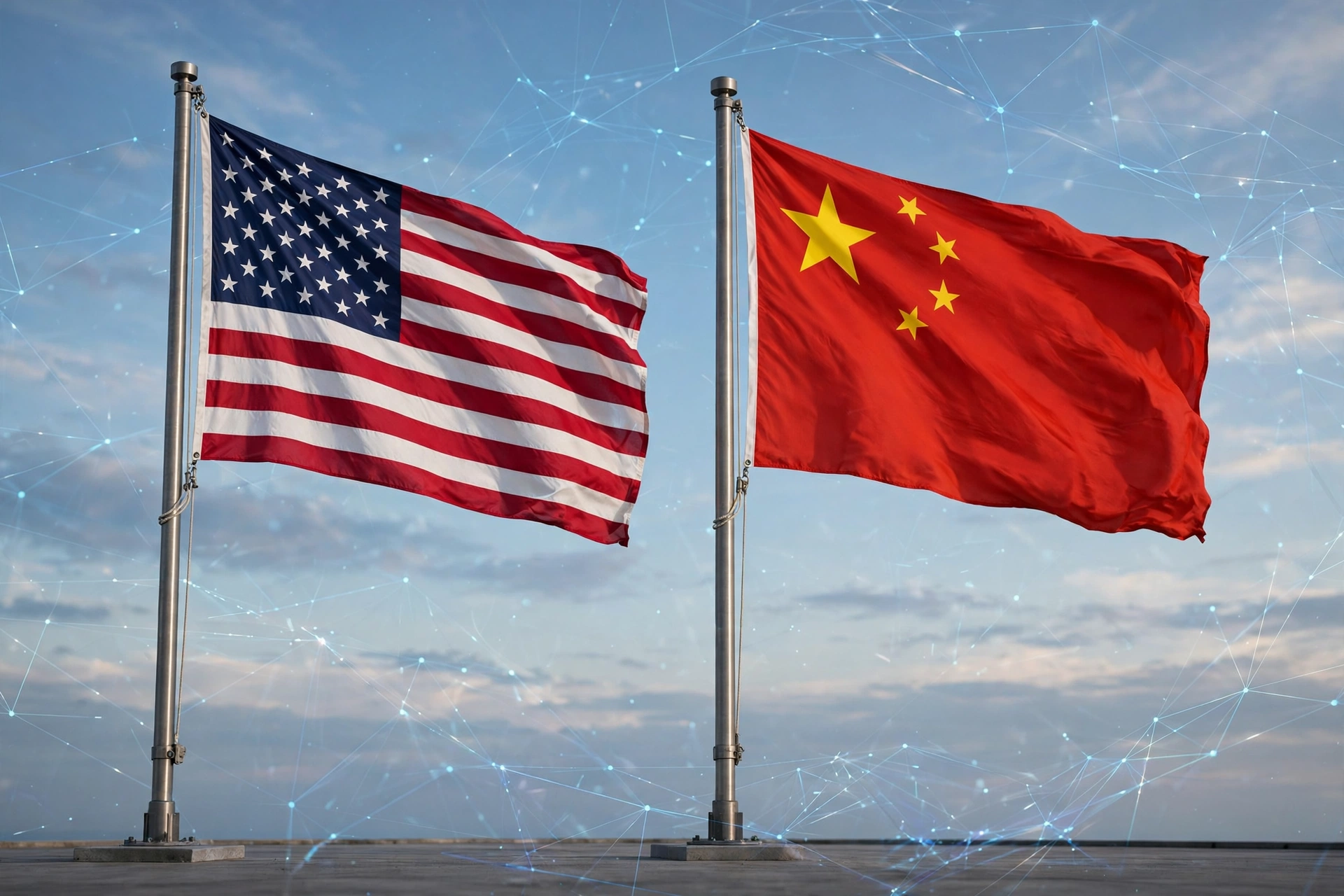
China and the United States agreed to set up a US China AI communication channel for artificial intelligence incidents, both sides said, after a Washington summit short on breakthroughs. The announcement — reported by Agence France-Presse — was the closest thing to a tangible AI policy outcome from a three-day state visit by Chinese President Xi Jinping that wrapped Friday, September 25. It was Xi’s first visit to the United States since 2015.
What the two sides agreed on AI
The White House said on Friday that the nations agreed to establish a “bilateral communication channel” for AI incidents, and Chinese state media confirmed the AI hotline was agreed in a report about the summit’s outcomes on Saturday, according to AFP. Beyond the label itself, no details about how the channel will work, who staffs it, or what counts as an “AI incident” have been disclosed so far — and the White House said on Friday that both leaders discussed AI alongside trade and the stalled war in Iran.

U.S. Trade Representative Jamieson Greer said on Friday that details of the talks will be released on Monday, per a weekend roundup of the summit. So the scope of the AI channel — and whether it amounts to a genuine safety mechanism or a diplomatic gesture — is still unverified.
The two leaders struck different tones on AI itself. Trump has repeatedly dismissed fears that AI could pose a threat to humanity, while Xi took a more measured tone, noting the technology must develop under human control, AFP reported.
Beyond AI: the summit’s other deals
The White House reported several concrete outcomes from the visit. China agreed to import at least 10 million metric tons of coal from the United States in 2027 and 2028, and the two countries agreed on more favorable tariff treatment for $30 billion of “non-sensitive goods” in each direction, AFP reported. And in the summit’s most crowd-pleasing announcement, Xi said a pair of pandas will be sent to Zoo Atlanta.
Trump and Xi discussed matters ranging from AI and trade to the stalled war in Iran, and confirmed they would meet for a third and fourth time this year at international summits in China and the United States: the APEC summit in Shenzhen in November and the G20 forum at Trump’s Doral resort in Miami in December, AFP reported. Xi also said his Washington trip had added “new substance” to his summit with Trump in Beijing in May, and that they had agreed to “strategic stability on the basis of respect, fairness, and reciprocity.”
Pomp, bonhomie, and a farewell salute
Xi’s visit was marked more by pomp than substance, but the message from both sides was that the summit had nevertheless helped smooth tensions, AFP reported. Xi wrapped up the three-day visit with a 21-gun salute farewell at the airport, per the LinkedIn weekend roundup. Trump rolled out the red carpet throughout the visit, treating Xi to a state banquet full of US tech titans, plus military parades, a flyover, and even a tour of his new White House helipad and ballroom — followed by a joint tour of the National Archives Museum on Friday to view records of the U.S.-China relationship.
“One of Friendship, Strength, and Success, for both China and the U.S.A.” — that’s how Trump described the meeting. “We’ve made great strides, very positive for both countries,” Trump told reporters as he had tea with Xi at the White House on Friday before the archives trip, per AFP.
Iran talks and what comes next
Trump confirmed during the archive visit that the two leaders had discussed the US-Israeli war in Iran, which AFP reports is approaching its seven-month mark. The Republican has faced pressure from Democrats and his own party to confront Xi over reports that Beijing has supplied Tehran with intelligence for attacks on US troops. Asked at the National Archives whether there would be progress on reopening the Strait of Hormuz — crucial for the flow of oil — Trump replied: “I think we’re going to do great.”
Whether the AI communication channel becomes anything more than a headline will likely depend on the details U.S. Trade Representative Greer is expected to release on Monday, and on the follow-up meetings in Shenzhen and Miami later this year. For now, the announcement marks the first formal U.S.-China AI incident mechanism to emerge from a summit that both sides framed as a reset of a deeply strained relationship.
FAQ
What is the US-China AI communication channel?
It’s a bilateral channel for artificial intelligence incidents that both sides agreed to establish during the September 2026 Washington summit. How it will work and what qualifies as an “AI incident” have not been disclosed.
When was Xi Jinping’s last visit to the United States before this one?
The visit was Xi’s first to the US since 2015, according to the weekend roundup of the summit.
What else was agreed at the summit?
According to AFP: China will import at least 10 million metric tons of US coal in 2027 and 2028, both countries agreed to more favorable tariff treatment for $30 billion of “non-sensitive goods” each way, and a pair of pandas will go to Zoo Atlanta.
When do Trump and Xi meet next?
Both leaders confirmed they will meet again at the APEC summit in Shenzhen, China, in November and at the G20 forum at Trump’s Doral resort in Miami in December, per AFP.
Sources:
- Agence France-Presse via The Manila Times, “China, US to open AI ‘communication channel’ after summit” (Sept. 26, 2026) — https://www.manilatimes.net/2026/09/26/world/china-us-to-open-ai-communication-channel-after-summit/2433478
- LinkedIn / China Biz Buzz, “Weekend Buzz: 26-27 September 2026” — https://www.linkedin.com/pulse/weekend-buzz-26-27-september-2026-china-biz-buzz-9kfvc

[…] worth separating two questions: Apple’s eligibility list covers Siri AI and Apple Intelligence specifically, not the full iOS 27 install. Owners of older, non-Apple Intelligence iPhones should […]